

Yes. Metricon recently completed two prefabricated homes in Melbourne in just 20 days from slab pour to completion. This faster construction method could help Australia deliver more homes, especially in areas where builders struggle to find enough skilled trades.
Australia needs more housing, but traditional construction takes time. Prefabricated homes could help speed things up by moving much of the building work from the construction site into a factory.
What Are Prefab Homes?
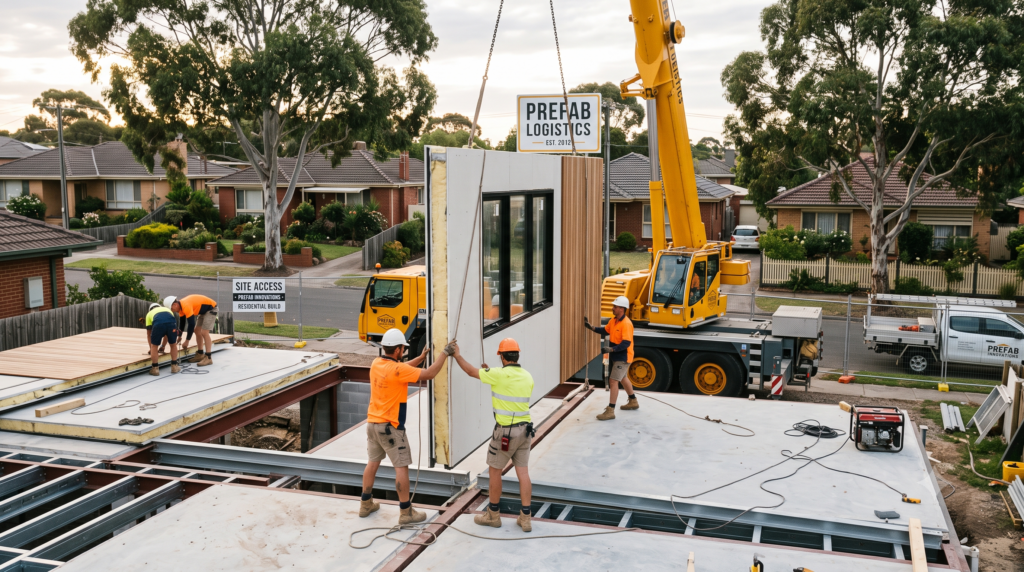
Builders create major parts of a prefabricated, or “prefab”, home away from the building site.
They then transport those components to the property and assemble them onsite.
Think of it a little like building with Lego. Instead of constructing every wall piece by piece onsite, large sections arrive ready for installation.
Metricon recently tested this approach in Melbourne.
The builder completed two prefab homes at Stockland’s Mt Atkinson estate in Truganina, around 22km west of Melbourne’s CBD. The project took just 20 days from slab pour to completion.
Metricon and its project partners completed about 90% of each home offsite before transporting the components to the development.
How Can Builders Complete a House in 20 Days?
The huge time saving comes from changing where builders do much of the work.
With traditional construction, different trades often need to complete their jobs in a set order. Delays at one stage can then affect the stages that follow.
Prefab construction changes that process.
Teams can manufacture major components in a factory while other work continues onsite.
Metricon’s pilot reached a weatherproof lock-up stage in only four days.
The completed homes included:
- Three bedrooms
- Two bathrooms
- Open-plan living
- Seven-star energy ratings
- Prefabricated wall panels
- A prefabricated bathroom module
Metricon worked with prefabricated construction company Signex and developer Stockland on the trial.
This project shows that the idea can work in the real world. The next challenge is finding out whether builders can repeat it at scale.
Do Faster Prefab Homes Cost Less?
Not necessarily.
This distinction matters for property investors and home buyers.
Speed is the major breakthrough demonstrated by this project.
A faster construction time does not mean the total cost of a new home will fall at the same rate.
Developers and buyers still need to pay for:
- Land
- Materials
- Manufacturing
- Transport
- Site preparation
- Labour
- Finance
- Approvals
- Fixtures and finishes
So, a 20-day build does not automatically mean a dramatically cheaper house.
Instead, the bigger opportunity may come from delivering more homes faster. Builders could also reduce some of the delays that affect traditional onsite construction.
Where Could Prefab Housing Make the Biggest Difference?
Regional Australia could provide one of the strongest opportunities.
Many regional areas struggle to attract enough skilled workers for major construction programs. That shortage can slow projects and make it harder to deliver new homes.
Metricon has identified regional and growth areas as potential markets for this construction method.
Large developments could also suit prefab construction.
For example, imagine a developer needs to build 40 similar homes in one location. Manufacturing major components together could create efficiencies that builders cannot achieve when they treat every home as a separate project.
Prefab construction could suit:
- Affordable housing projects
- Build-to-rent developments
- Regional housing
- Townhouse developments
- Large residential estates
- Worker accommodation
Australia does not need one single solution to its housing challenges. Prefab could become one more way to increase the speed of new housing delivery.
Step-by-Step: What Needs to Happen Next?
Building two homes quickly proves the concept can work. Building thousands of them creates a much bigger challenge.
Here are five areas the industry will need to address.
1. Prove the Construction Model
Builders need to show that prefab homes can consistently meet Australian building standards and customer expectations.
Speed matters, but buyers will still expect quality.
2. Get Lenders Comfortable
Banks and other lenders play a major role in construction.
They need confidence in the building method, valuation process and finished property before prefab can become an easy option for everyday buyers.
3. Work Through Planning and Approvals
Faster construction does not remove planning and building requirements.
Developers still need to work with councils and other authorities to meet the relevant rules.
4. Make the Numbers Work at Scale
A successful pilot is a great start.
However, builders must prove that the model makes financial sense across hundreds or thousands of homes.
Scale could make a major difference.
5. Win Over Australian Home Buyers
Buyers need confidence before prefab housing becomes mainstream.
They will naturally ask questions about quality, appearance, durability, finance and resale value.
Builders who answer those questions clearly may find a growing market for faster construction.
Will Prefab Homes Replace Australian Tradies?
Probably not.
Prefab construction changes where some of the work happens. It does not remove the need for skilled workers.
Projects still need people to handle onsite assembly, connections, installation, finishing and inspections. Factories also need skilled workers to manufacture the components.
Prefab may instead help the industry use its workforce more efficiently.
That could prove especially useful in regional areas where builders already struggle to find enough skilled labour.
Could Prefab Homes Help Australia Build Faster?
Metricon’s trial does not mean every Australian home will soon take 20 days to build.
However, the project shows what faster construction can look like.
Metricon and its partners completed two three-bedroom homes in Melbourne using a system that moved most of the construction work offsite.
Now comes the bigger test.
Can builders repeat the process across hundreds of homes? Will lenders support the construction model? Can developers make the numbers work? Most importantly, will Australian families want to live in these homes?
If the industry can answer those questions, prefab homes could become an important part of Australia’s housing future.
For property investors, developers and home buyers, this is a construction trend worth watching.